About GREENEDGE
About the Project
GREENEDGE brings together sustainable entrepreneurship, flexible learning,
AI-supported education and practical innovation to strengthen green skills
in higher education.
Project at a glance
Erasmus+
KA220-HED Cooperation Partnership
36
months
7
partner organisations
6
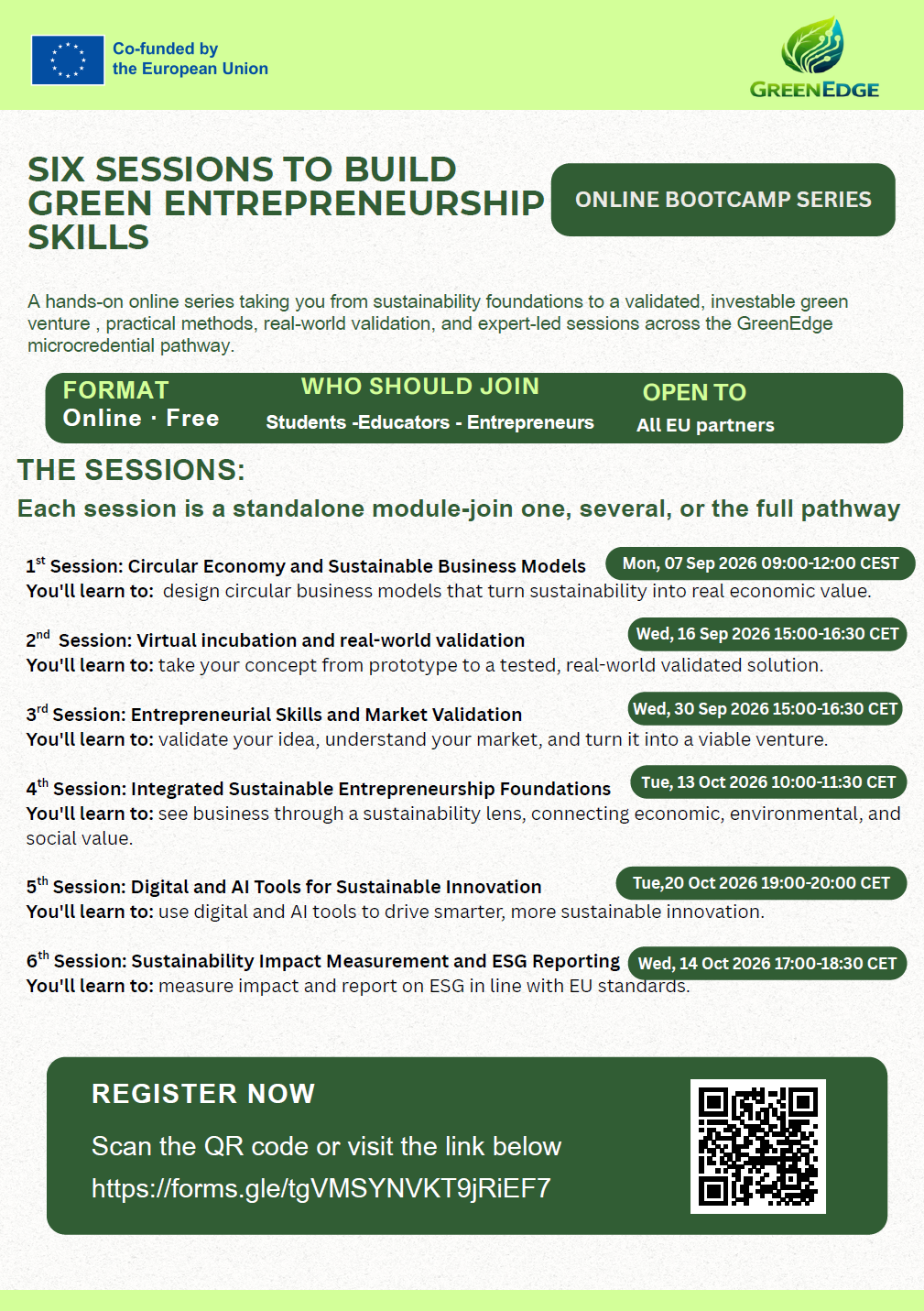
learning modules
Why GREENEDGE was created
Skill gaps
Students and aspiring entrepreneurs need stronger competencies
for sustainable business and innovation.
Flexible learning
Learners need accessible and modular learning opportunities
that can fit different contexts and needs.
Engagement
More interactive and technology-supported learning can complement
traditional approaches.
Practical development
Learners benefit from opportunities to develop ideas through
experimentation, collaboration and practical work.
Project objectives
-
Provide green and entrepreneurial skills
-
Support educators with digital and pedagogical tools
-
Personalize learning through AI
-
Support idea development through mentorship and collaboration
-
Promote circular-economy innovation
Mission
Bridge the green-skills gap in higher education by combining
sustainability, entrepreneurship, AI-supported learning,
and practical venture development.
Who is it for?
Students
Higher education learners interested in sustainability
and entrepreneurship.
Educators
Teachers and academic staff interested in innovative
learning approaches.
Aspiring entrepreneurs
Learners developing sustainable business and innovation ideas.
Mentors / industry
Practitioners supporting applied learning and business development.
WP2 Research
Research & Key Findings
GREENEDGE research under WP2 analysed sustainable entrepreneurship education
across six partner countries: Ireland, Turkiye, Germany, Cyprus, the Netherlands
and Poland. Combining education-system benchmarking, quantitative research and
focus groups with students, entrepreneurs, mentors, practitioners and educators,
the study identified competency gaps and priorities for practice-oriented
micro-credential learning pathways and virtual incubation.
What the research shows
Sustainable entrepreneurship is an increasingly important priority across Europe,
shaped by the green transition, ESG-related requirements, digital transformation
and changing labour-market needs. However, the integration of sustainability,
entrepreneurship and digital competences varies between countries and education
systems. The research highlights a shared need to move beyond fragmented
theoretical knowledge towards interdisciplinary, practical learning.
Application Gap
Learners may understand sustainability concepts but need more opportunities
to apply them to real business challenges and innovation.
Integration Gap
Sustainability, entrepreneurship, AI, circular economy and digital skills
are often developed separately rather than as an integrated competence set.
Access Gap
Access to incubators, mentoring, business collaboration and applied projects
remains uneven and is not always embedded in educational programmes.
Competences learners want to strengthen
Students show motivation and digital readiness, but report a need for more
practical preparation in areas such as:
Sustainable Business Models
Designing viable business models that integrate sustainability principles.
Market Validation
Testing business ideas, understanding customer needs and assessing feasibility.
ESG Impact Measurement
Assessing and communicating environmental and social impact.
AI & Digital Tools
Using AI strategically to support sustainable innovation and decisions.
Six integrated learning areas
In response to the findings, GREENEDGE proposes six connected micro-credential
areas designed to link knowledge with practical entrepreneurial action.
AREA 01
Foundations of Sustainable Entrepreneurship and Systems Thinking
AREA 02
Circular Economy and Sustainable Business Models
AREA 03
Impact Measurement and ESG Reporting
AREA 04
Digital and AI Tools for Sustainable Innovation
AREA 05
Entrepreneurial Competences and Market Validation
AREA 06
Virtual Incubation and Real-World Project Implementation
From research to action
The findings point to the importance of experiential and challenge-based learning,
mentoring, AI-supported tools and stronger cooperation between higher education
and business. GREENEDGE aims to connect education with the green economy by
supporting learners from idea generation and validation through to implementation
of sustainable solutions.
Learning
Learning Pathways
GREENEDGE develops microcredential-based learning pathways for sustainable
entrepreneurship, combining flexible participation with practical learning
and European competence frameworks.
6
learning modules
3 ECTS
per module
18 ECTS
total pathway
540
total learning hours
The 6 Learning Modules
MODULE 01
Sustainable Entrepreneurship Foundations
Building integrated sustainability, entrepreneurship
and systems-thinking competences.
MODULE 02
Circular Economy & Sustainable Business Models
Applying circular-economy principles to sustainable
business model development.
MODULE 03
Sustainability Impact Measurement & ESG Reporting
Developing skills for sustainability measurement,
impact assessment and ESG reporting.
MODULE 04
Digital & AI Tools for Sustainable Innovation
Using digital tools and AI to support analysis,
innovation and sustainability-oriented decisions.
MODULE 05
Entrepreneurial Skills & Market Validation
Developing ideas, understanding customers and assessing
financial and market feasibility.
MODULE 06
Virtual Incubation & Real-World Project Implementation
Moving from entrepreneurial ideas towards practical
development and implementation.
From learning to action
Understand
Analyse
Design
Validate
Measure
Implement
Reflect & Improve
Three levels of impact
Micro
Individual knowledge, awareness and competences.
Meso
Organisational and institutional application.
Macro
Systems-level thinking and transformation.
Recognition
EQF Level 6, ECTS-based learning and digital credentials.
Digital learning
AI Gamified Course
A personalized online learning experience supported by AI,
gamification and flexible learning formats.
AI personalization
Learning support adapted to learner needs and progress.
Gamification
Interactive elements designed to increase motivation
and learner engagement.
Digital credentials
Recognition of learning achievements through digital
credentials.
Flexible learning
Online learning designed to support different learner contexts.
Future skills
Skills for the Green Economy
GREENEDGE connects sustainability knowledge with entrepreneurial thinking
and digital skills needed in a changing economy.
ESG & Sustainability Reporting
Understanding sustainability indicators, reporting
and compliance.
Circular Economy
Applying circular principles to products, services
and business models.
Sustainable Business Models
Designing solutions that combine environmental
and economic value.
AI & Digital Innovation
Using digital tools and AI to support analysis,
innovation and decision-making.
From ideas to action
Virtual Incubator
A digital environment for collaboration, innovation and sustainable
business development.
Challenges
Work on practical sustainability and entrepreneurship challenges.
Mentorship
Develop ideas with guidance, feedback and collaboration.
Prototyping
Test and refine solutions before implementation.
Implementation
Move from validated ideas towards practical application.
From problem to implementation
Problem
Idea
Solution
Validation
Implementation
Consortium
Project Partners
Meet the organisations contributing their expertise to GREENEDGE.
Select a partner's logo or name to visit its website.
AGH University of Krakow is a large public technical university (established 1919, part of the knowledge triangle of education, research and innovation) with around 18,900 students and over 1,800 academic staff. AGH runs an active sustainability agenda, from renewable-energy education and its own greenhouse-gas monitoring station to a green campus, apiary and photovoltaic installations, and holds the Erasmus Charter for Higher Education. As project coordinator, AGH leads overall project management and, within WP2, the research and needs-analysis phase that underpins the learning pathways, drawing on the Faculty of Management's expertise in green organisational behaviour, circular economy and the use of AI in people management.
Konnektable Technologies (KT) is a technology research and development SME founded in 2013, with offices in Ireland, Greece and the USA. KT specialises in AI- and data-driven software products, including machine learning, data mining, semantics and analytics, and has extensive experience delivering Erasmus+ and other EU-funded R&D and EdTech projects. Within GreenEdge, KT contributes its technological expertise to the AI-powered components of the learning pathways and the gamified course, and to system architecture and dissemination.
Innomate is an SME of 15 staff specialising in gamified, technology-enabled learning solutions, combining game mechanics such as points, badges and leaderboards with curriculum design for entrepreneurship and sustainability education. Innomate has led adult-education Erasmus+ projects on entrepreneurship and gamification, including GAMEUP, Includeup and EntreAdu, and leads WP2, including Activity T4 - Development of the pathways, the deliverable this document forms part of.
CEA is an SME founded in 2020 as a research-based spin-off of the Circular Economy Research Center at Ecole des Ponts Business School. It runs an award-winning Circular Economy Specialist certification programme and is supported by a Strategic Foresight Board drawing on experts from institutions including Harvard, McKinsey and NASA. CEA brings deep circular-economy training, consulting and dissemination expertise to the design of the GreenEdge learning pathways and to the project's broader outreach activities.
Smart Education Hub is a Berlin-based organisation providing human-centred training, career-transition coaching and business mentoring, with particular experience supporting young professionals, migrants and professionals in the cultural and creative sectors. Its coaching and mentoring methodologies inform GreenEdge's approach to learner support and engagement, particularly for aspiring entrepreneurs moving between career stages.
THUAS is a large public university of applied sciences with more than 25,000 students across four campuses in South Holland. Its Centre of Expertise Mission Zero, spanning the Energy in Transition, Circular Business, Urban Metabolism and Designing Value Networks research groups, conducts practice-oriented research into sustainable entrepreneurship and the circular economy. THUAS leads the identification of core micro-credential topics within WP2, working closely with AGH and drawing industry input from Smart Education Hub and Innomate.
ACEEU - the Accreditation Council for Entrepreneurial & Engaged Universities - is an international quality-assurance and EU-project development body that has supported universities' entrepreneurial and social transformation since 2016. It has been involved in more than 60 EU-funded projects since 2020, working with over 300 higher education institutions across 35+ countries, and frequently leads quality assurance, dissemination and sustainability tasks - the role it is expected to play within the GreenEdge consortium.
Updates
News & Events
Discover the latest GREENEDGE news, activities, results
and project developments.
GREENEDGE Newsletter 1
Available in four languages:
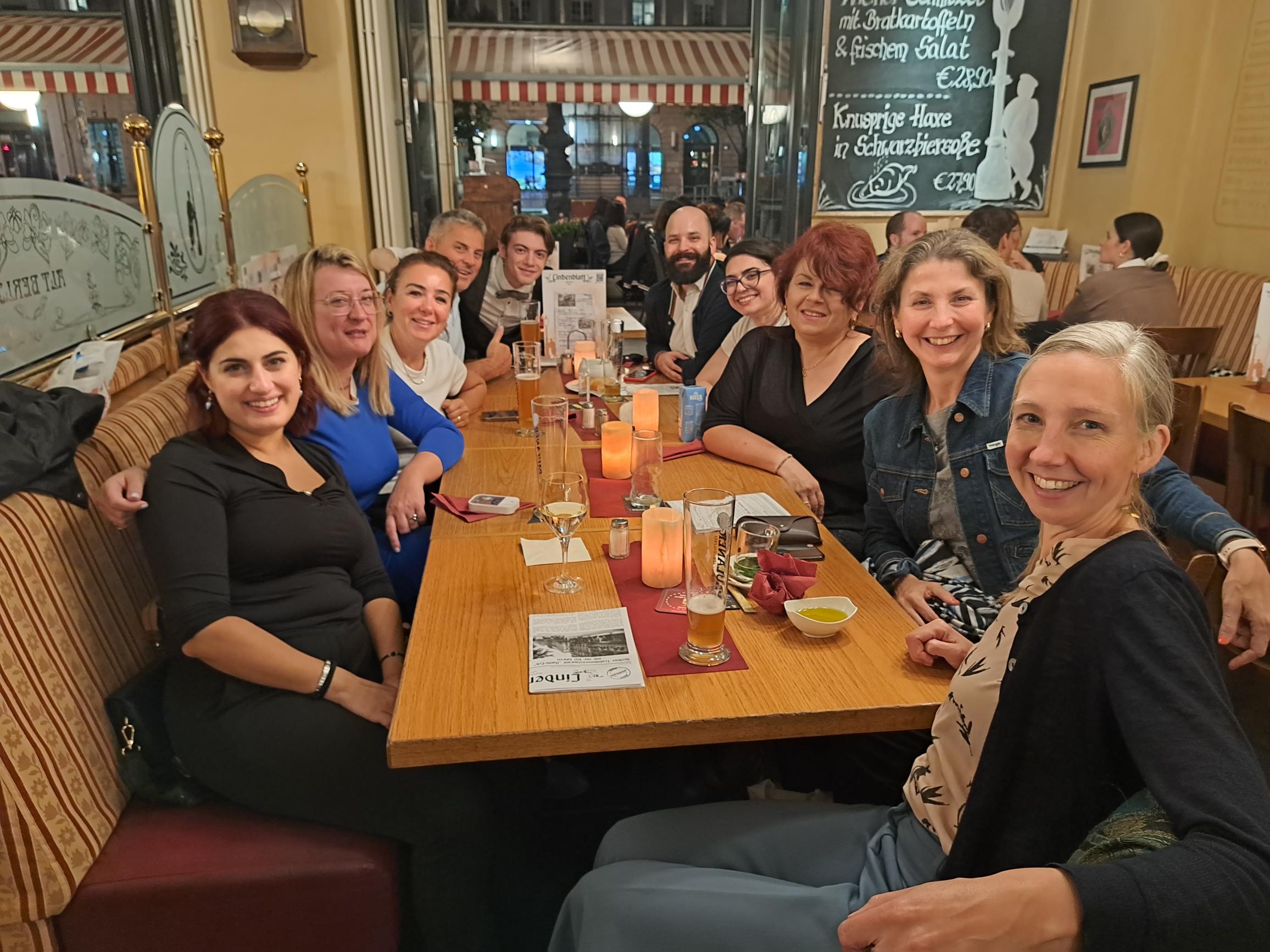
GreenEdge Partners Meet in Berlin
The GreenEdge consortium met in Berlin on 29 September 2026
for its 2nd Transnational Project Meeting. Partners reviewed
project progress, discussed the learning pathways and coordinated
the next stages of AI personalisation, online course development,
the Bootcamp and dissemination activities.
29 September 2026 | Berlin, Germany